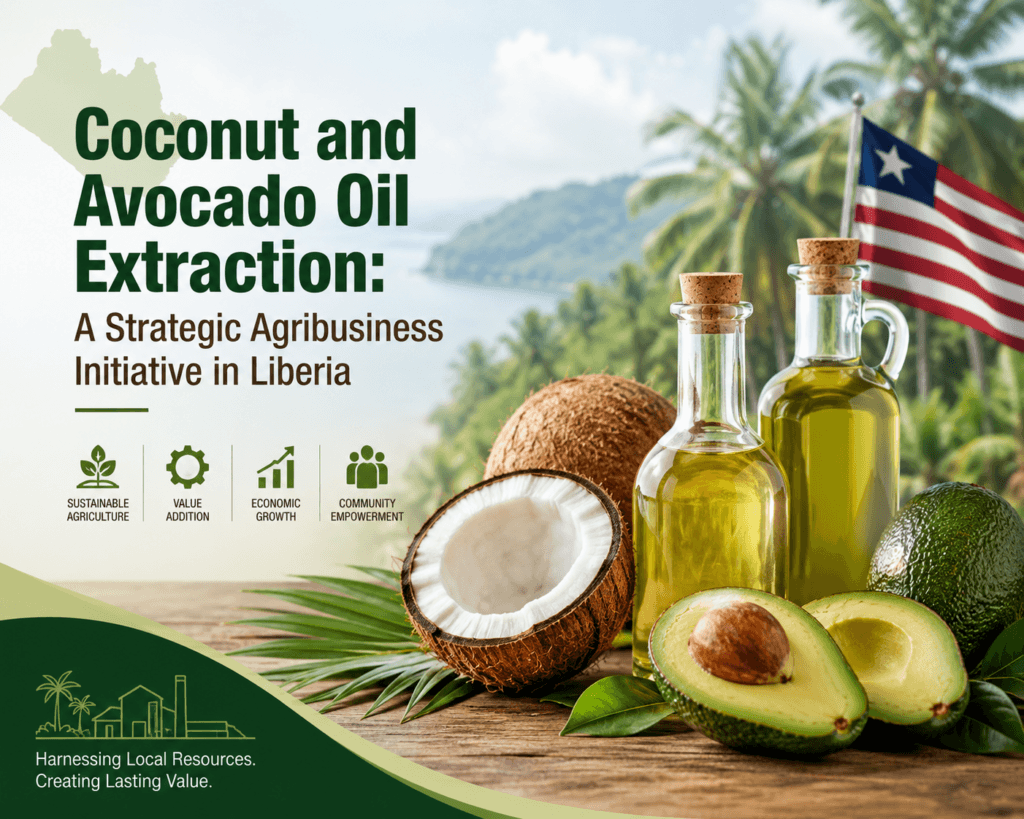
Coconut and Avocado Oil Extraction: A Strategic Agribusiness Initiative in Liberia
Context and Rationale
Liberia’s southeastern corridor offers the right ecological and logistical conditions for perennial crops such as coconut and avocado. With its humid coastal climate, fertile soils, and proximity to key transport infrastructure, the region provides a sound base for developing agro-industrial ventures. The proposed Coconut and Avocado Oil Extraction Facility aims to promote value addition, enhance farmer participation, and expand the country’s export portfolio through a modern processing and distribution system.
Market Overview
Global demand for plant-based oils continues to rise as consumers shift toward natural, traceable ingredients.
- The coconut oil market is forecast to grow from USD 5 billion in 2024 to USD 7.5 billion by 2029, reflecting 8.4 percent average annual growth.
- The avocado oil market is projected to expand from USD 611 million to USD 886 million by 2033, a 4.2 percent annual rate.
This trend—driven by health awareness, cosmetics production, and food-processing innovation—presents opportunities for Liberia to diversify exports and substitute certain imports through local processing.
Project Structure
The facility integrates cultivation, processing, and trade under one operational framework.
- Cultivation: Establishment of 10,000 hectares of avocado and roughly two million coconut trees through structured out-grower arrangements.
- Processing: A plant with a 15,000 metric-ton annual capacity, producing both edible and cosmetic-grade oils.
- Infrastructure: Warehouses, quality-control laboratories, cold-chain systems, and solar-powered energy solutions.
- Distribution: Connection to the Buchanan Special Economic Zone and Freeport of Monrovia for regional and international shipments.
The production ratio—about 60 percent coconut oil to 40 percent avocado oil by volume—balances reliable supply with higher-value output.
Investment Profile
The total estimated capital requirement is USD 30 million, allocated as follows:
- Processing equipment and machinery – USD 12 million
- Land preparation and cultivation – USD 8 million
- Warehousing, utilities, and cold chain – USD 5 million
- Working capital and operations – USD 3 million
- Training, research, and quality control – USD 2 million
Financial modelling yields an NPV of USD 29.8 million, an IRR of 25.7 percent, and a five-year payback period at a 12 percent discount rate. Even under a 20 percent price reduction, returns remain above benchmark levels, indicating relative stability.
Operational Outlook
At steady state, the operation is expected to achieve an EBITDA margin of roughly 23 percent, with raw-material inputs representing about half of total costs. The break-even point is around 18 percent of production capacity, meaning the plant could maintain viability even in periods of lower output or price pressure.
Implementation Timeline
Development is planned over 30 months, in five overlapping phases:
- Feasibility and planning – site selection, impact assessment, and business finalization.
- Regulatory and financial closure – licensing, special-purpose-vehicle setup, and investor agreements.
- Infrastructure development – construction of plant facilities, utilities, and storage.
- Equipment installation and cultivation – machinery setup and engagement of smallholders.
- Commissioning and scale-up – product testing, certification, and commercial launch.
Full production is targeted within five years of commencement.
Socio-Economic Contributions
The facility is projected to create around 13,000 direct and indirect jobs, support over 5,000 smallholder farmers, and generate USD 10 million in annual export revenue. A 40 percent female employment target is embedded in the project’s staffing plan. Beyond employment, it will introduce quality standards, training, and sustainable farming practices in participating communities.
Policy Environment
The initiative aligns with Liberia’s ARREST Agenda for Inclusive Development, which emphasizes agricultural modernization and industrial value addition. Incentives for investors include a 10-year tax holiday, duty-free import of equipment, and full foreign-ownership rights with free repatriation of profits.
Participation can take the form of a public–private partnership, with government equity of 20–30 percent, or a fully private model allowing complete operational control.
Conclusion and Next Steps
The Coconut and Avocado Oil Extraction initiative demonstrates how targeted agribusiness investment can extend beyond raw-commodity trade to build competitive processing industries. It seeks to combine economic diversification, regional trade growth, and local job creation in a single integrated framework.
📘 For further technical and financial details, readers can download the Pre-Feasibility Investor Teaser prepared by the National Investment Commission. The document outlines key assumptions, projected returns, and implementation milestones for prospective partners interested in exploring participation.